
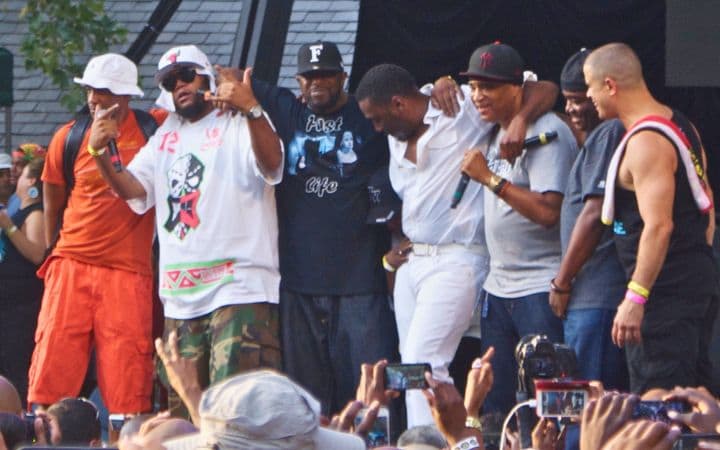

Members of the Juice Crew at the 2015 Rock Steady Crew Anniversary Pictured: Masta Ace, Craig G, Kool G Rap, Big Daddy Kane, Marley Marl, DJ Polo, and Crazy Legs
Cold Chillin' Records occupies an odd space in hip-hop history. It was a label distributed by Warner Bros. that helped push street rap into mass-market visibility, yet it rarely gets the same retrospective attention as Def Jam or Tommy Boy. On the latest episode of Queue Points, hosts DJ Sir Daniel and Jay Ray dig into why that is, using the recent death of label co-founder Tyrone "Fly Ty" Williams as the entry point into a broader conversation about the Juice Crew and the artists who came up under Cold Chillin's banner.
One correction drives much of the episode: Cold Chillin' Records "Marley Marl did not found Cold Chillin," Jay Ray says on the episode. "He did not found the label, even though my entire childhood, Cold Chillin was Marley Marl's label, but it was actually of course, Fly Ty and Len Fichtelberg."
That distribution deal mattered because it gave Cold Chillin's roster — pulled largely from Queensbridge, Brooklyn, and Long Island — the kind of budget, media exposure, and video rotation independent labels couldn't offer. DJ Sir Daniel frames the label's ambition directly: "Not only do we have a sickening roster of MCs hailing from Queensbridge and Brooklyn and Long Island. Now we've got major distribution... So Cold Chillin, literally, was in the, in the game like, oh, we are here."
Listen To These Related Episodes
Cold Chillin Records: The Juice Crew, Big Daddy Kane, Roxanne Shanté And Biz Markie
This episode dives into Cold Chillin' Records and how Fly Ty and Len Fichtelberg built a Queensbridge-backed powerhouse with Warner Brothers distribution, clarifying that...
How Queensbridge and Marley Marl Shaped Black Music History
This episode of Queue Points explores how Queensbridge and Marley Marl shaped Black music history, weaving together the neighborhood’s community spirit, fierce hip-hop ri...
Verzuz Recap: A Night of Real Hip Hop with Big Daddy Kane & KRS-One
In Verzuz Recap: A Night of Real Hip Hop with Big Daddy Kane & KRS-One, the world witnesses four cornerstone elements of hip hop—deejaying, MCing, beatboxing, and b-boyin...
The label's catalog reads like a syllabus for late-'80s New York rap. Big Daddy Kane's 1988 debut Long Live the Kane combined lyrical technicality with a showman's stage presence that the hosts compare to a hip-hop version of Michael Jackson's performance style. Biz Markie built a following as the crew's beatboxer and "Clown Prince of Hip Hop" before scoring the label's biggest crossover hit with "Just a Friend" in 1989. Roxanne Shanté, despite being the artist around whom much of the Juice Crew's mythology formed, didn't release a full-length album until 1989's Bad Sister — years after her run of singles like "Roxanne's Revenge" and "Have a Nice Day." Kool G Rap and DJ Polo's Road to the Riches is credited in the episode with laying groundwork for what would later be labeled mafioso rap.
The crew's most enduring group recording, "The Symphony," appeared on Marley Marl's 1988 album In Control, Volume 1 and featured Masta Ace, Big Daddy Kane, Kool G Rap, and Craig G trading verses over a single beat. Rolling Stone has called it "the first truly great posse cut," a designation Jay Ray echoes on the episode: "That is the posse cut to kill all posse cuts... a moment in time that has never been able to be replicated."
Enjoy the Music of Cold Chillin'
Biz Markie's crossover success also led directly to one of the more consequential legal decisions in music history. His 1991 song "Alone Again," which sampled Gilbert O'Sullivan's 1972 hit "Alone Again (Naturally)" without a license, resulted in Grand Upright Music, Ltd. v. Warner Bros. Records, Inc. Judge Kevin Duffy ruled against Biz Markie, opening his decision with "Thou shalt not steal," and the ruling effectively ended the era of uncleared sampling in hip-hop production, forcing labels to build out formal sample-clearance processes still in use today. Biz Markie's next album carried the pointed title All Samples Cleared!
Jay Ray connects the dots on the episode: "That is literally because of the outcome of this lawsuit... which basically sparked what we do now as it comes to sampling in terms of sample clearances."
Cold Chillin' shut down in 1998, and its catalog was later acquired by Traffic Entertainment. But the run it had between 1986 and the early '90s — anchored by Marley Marl's production, Fly Ty's management, and a roster stacked with technically gifted MCs — helped define what a golden-era hip-hop label could look like under major distribution.
Watch
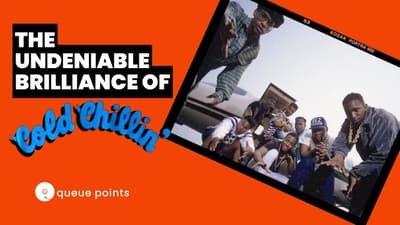
Marley Marl Didn't Found Cold Chillin'... So Who Actually Did?
Marley Marl didn't found Cold Chillin' Records — Tyrone "Fly Ty" Williams and Len Fichtelberg did, and that founding story anchors this Queue Points episode on the Juice ...
Editor's Note: Blog post was developed using AI assistance to repurpose content from our original episode, "Cold Chillin Records: The Juice Crew, Big Daddy Kane, Roxanne Shanté And Biz Markie," and was subsequently reviewed, fact-checked, and edited by the Queue Points team to ensure accuracy and voice.