
Editor’s Note: This blog post was developed using AI assistance to repurpose content from our original episode, From Schoolly D to N.W.A.: The N-Word in Rap, and was subsequently reviewed, fact-checked, and edited by the Queue Points team to ensure accuracy and voice.

In 1979, the same year the Sugar Hill Gang introduced rap to the pop charts, an MC named Scoopy (a name spelled "Scoopie" in the actual lyrics of the song) slipped the word nigga into "Scoopy Rap" with little fanfare. "Family Rap" did the same that year; Grandmaster Flash & the Furious Five's "New York New York" carried it further in 1983. The linguistic seed was planted underground, and began a slow ascent into commercial prominence. It would take nearly a decade to bloom into something the mainstream couldn't ignore.
That history is the foundation of the latest Queue Points episode, where DJ Sir Daniel and Jay Ray sit with a question that has haunted hip-hop scholarship for forty years: did the reclamation actually work?
The Schoolly D Inflection Point
The record most historians point to as the lexical inflection point is Schoolly D's "P.S.K. What Does It Mean?", released in 1985 on his own independent Philadelphia label. Schoolly told Billboard on the song's 30th anniversary that he and DJ Code Money made it in cottage-industry fashion and watched it become an anthem from Philly to the West Coast. It is now widely credited as the first gangsta rap song, and according to the Wikipedia entry on the track, it contains one of the earliest prominent uses of nigga in a rap record. Ice-T has cited it as the direct blueprint for "6 'N the Mornin'." As Jay Ray notes in the episode, "P.S.K." never charted on traditional radio — it traveled through dubbed cassettes and word of mouth, a reminder that the word's mainstreaming was an underground project long before it was a major-label one.
N.W.A. and the Mainstreaming Event
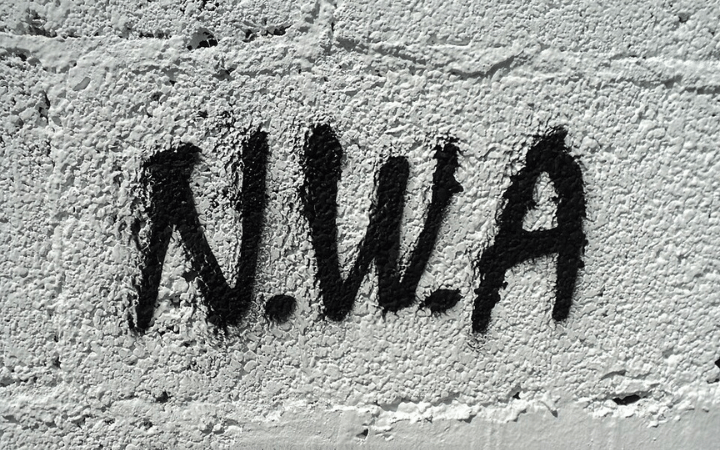
When N.W.A. released Straight Outta Compton on August 8, 1988, the equation changed. The BBC's retrospective notes the album brought gangsta rap to mainstream America, and the Wikipedia entry on N.W.A. underscores the demographic shift: the group "was credited with being the first to open up rap to a white American audience." By 1991, Niggaz4Life became the first hardcore rap album to top the Billboard 200.
"NWA opened the door to the word nigga being used everywhere." — Jay Ray
That commercial breakthrough is also where the -er / -a distinction crystallized in popular discourse — the 1990s argument that one spelling marked in-group solidarity while the other remained a slur. Patricia Chesley's 2011 PLOS ONE study documents how non-Black listeners began absorbing African-American English vocabulary directly from rap records during this era — a finding with uncomfortable implications for the reclamation thesis.
The Scholarly Debate the Episode Walks Into
Two books frame the intellectual lineage behind this conversation. Harvard law professor Randall Kennedy's Nigger: The Strange Career of a Troublesome Word (2002) argued that the word's meaning is contextual and that in-group use can defang it. Jabari Asim's The N Word: Who Can Say It, Who Shouldn't, and Why (2004) pushed back, tracing the word's five-century history of dehumanization and questioning whether semantic reappropriation can ever fully neutralize that weight.
The episode lands closer to Asim. As Jay Ray puts it, the thesis "seemed like a good one at the time" — but in 2026, the evidence on the ground tells a different story.
"They don't want the struggle, they just want the shine." — DJ Sir Daniel
Who Gets the Pass — and Why Community Matters
The episode's most pointed stretch examines the cultural passes Black listeners have extended over the decades — to Bronx Latino MCs like Fat Joe, to Caribbean and Afro-Latino artists with kinship to hip-hop's geographic origins, and, more controversially, to Jennifer Lopez when she rapped the word on the 2001 Murder Inc. remix of "I'm Real." The hosts read these passes as data points about how community accountability operates inside Black music, and where it has failed. The corrective, they argue, lies in the Kendrick Lamar model: when a white fan rapped the word onstage during "m.A.A.d City" at the 2018 Hangout Festival, Kendrick stopped the show — a moment captured on video and recapped by BBC News — and taught the audience a different protocol. Rap the song. Respect the people. Skip the word.
Why This Episode Belongs on Your Playlist
What makes this Queue Points conversation valuable for any serious student of hip-hop is that it situates a deeply personal debate inside a verifiable timeline — Scoopy to Schoolly D to N.W.A. to J.Lo to Kendrick — and asks whether the genre's most foundational lexical choice has aged the way its earliest practitioners intended. Sir Daniel's framing of Black culture as the "Rolls-Royce of cultures" is, in effect, a brand-stewardship argument about who gets to define the terms of hip-hop's global reach. Press play. The receipts are all there.
Watch / Listen
[ YouTube Video Embed Placeholder ]
Watch the full episode on the Queue Points YouTube channel
[ Audio Player Embed Placeholder ]
Listen on Spotify, Apple Podcasts, or wherever you get your podcasts.