
![[Show Notes] John Crooms on Archiving Atlanta's Black Music Nightlife](https://images.beamly.com/fetch/https%3A%2F%2Fsites.beamly.com%2F65e385bcdcfc57fb25f741f6%2Fmedia%2Fdb6cf106953d2d288624.jpg?w=1200)
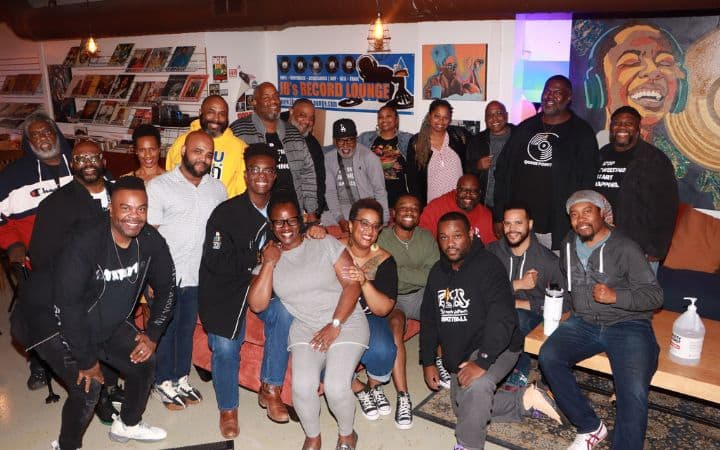
Group Shot From Queue Points Live 2023 (Credit: John Crooms)
Listen To This Episode
John Crooms on Archiving Atlanta's Black Music Nightlife
Veteran photographer John Crooms sits down with DJ Sir Daniel and Jay Ray to trace over three decades of Atlanta’s Black music nightlife, detailing why he prioritizes und...
The Big Picture
This episode examines the evolution of Atlanta’s Black nightlife and independent music infrastructure through the lens of photographer and archivist John Crooms. The discussion traces the shift from analog film documentation in the 1990s to modern smartphone club culture, contrasting the welcoming environment of house music spaces with the strict door politics of early hip-hop venues. Hosts DJ Sir Daniel and Jay Ray frame Crooms’ three-decade career as a vital historical record, highlighting how localized retail, college radio, and initiatives like the decennial "A Great Day in Atlanta" photoshoot have preserved the city's cultural memory and propelled its global influence.
Show Notes
Editor's Note: Show Notes were developed using AI assistance to repurpose content from our original episode, "John Crooms on Archiving Atlanta's Black Music Nightlife," and were subsequently reviewed, fact-checked, and edited by the Queue Points team to ensure accuracy and voice.
The Tangible Archive: Analog Nightlife in a Digital Era
Documenting nightlife before the digital era required a high level of technical patience, financial investment, and personal discretion. John Crooms began shooting in 1993, working entirely with analog photographic film. Navigating dark, crowded spaces like FunkJazz Kafé required him to operate stealthily to capture candid moments without disrupting the kinetic energy of the dancefloor.
The transition to digital photography in the early 2000s fundamentally changed how nightlife was preserved, processed, and consumed. In the analog era, reviewing negatives took time and intent. Crooms recalls the physical labor of his early career, specifically utilizing rapid-processing labs like Wolf Camera to develop film overnight. This allowed him to hand out physical prints to club-goers the very next day, creating a tangible, localized economy of memory where patrons collected physical stacks of his photography as proof of their participation in the city's nightlife. Today, the ubiquity of smartphones has altered the club experience entirely, shifting the focus from physical archiving to immediate digital broadcasting.
Crooms observes that contemporary crowds often prioritize recording multi-hour sets on their phones over being physically present in the moment, fundamentally altering the energy of live events.
Archival photography serves as a verified historical record. When questions arise about whether specific events occurred or who was present at foundational clubs like Club Kaya or Visions, Crooms' physical archive provides empirical evidence of the city's cultural lineage.
The role of the photographer in underground spaces requires a delicate balance of visibility and respect, especially in marginalized communities where subjects may not want flash photography drawing attention to them due to personal privacy or safety concerns.
Door Politics and the Sanctuary of House Music
The choice of which music scenes to document is often dictated by the culture surrounding the venues themselves. Crooms found himself naturally gravitating toward house music events over hip-hop parties due to a stark contrast in hospitality and access.
During the 1990s and early 2000s, entering hip-hop events often required navigating intense door politics, media credential checks, and restrictive security protocols. Unless a photographer was backed by a major publication or mainstream media outlet, access was routinely denied or strictly limited1. In contrast, house music communities fostered a more inclusive, communal environment. Spaces run by local DJs and independent promoters prioritized the music and the dancer over VIP hierarchies, allowing documentarians to work with less friction.
This inclusivity traces its roots back to foundational house and disco clubs, most notably New York City’s Paradise Garage. Operating from 1977 to 1987 in the SoHo neighborhood, the Paradise Garage was founded by Michael Brody with financial backing from Mel Cheren of West End Records. The venue was revolutionary for its time; it promoted dancing over verbal interaction, featured an award-winning custom sound system designed by Richard Long, and was the first major venue to place the DJ at the absolute center of attention. Though Crooms never attended the Paradise Garage before it closed during his freshman year of college in 1987, the club's ethos—championed by legendary resident DJ Larry Levan—functioned as a mythic blueprint for the underground dance spaces that later thrived in Atlanta. Levan's eclectic, emotionally driven sets, often referred to as "Saturday Mass" by his devoted followers, established a standard for musical diversity that Southern DJs sought to replicate.
The genre of house music itself, characterized by a repetitive four-on-the-floor beat and a tempo typically between 115 and 130 beats per minute, emerged from the queer Black underground club culture of Chicago in the early 1980s. Pioneers like Frankie Knuckles at the Warehouse and New York figures like Levan at the Garage developed a sound that relied heavily on drum machines (such as the Roland TR-808 and TR-909), synthesizers, and soulful, gospel-influenced vocal arrangements. This sonic architecture, particularly the lush chords and muted basslines of deep house, became the soundtrack to the inclusive spaces Crooms preferred to photograph.
The Crossover Era: When Hip-Hop, R&B, and Disco Converged
The musical boundaries between early hip-hop, disco, and R&B were highly porous in the late 1970s and early 1980s. Before hip-hop codified its own distinct fashion and sonic parameters, its pioneers pulled heavily from existing dance and funk cultures. Crooms notes that the aesthetics of early rap acts often mirrored the artists they idolized, resulting in stage wear that featured flamboyant, theatrical, and even fetish-inspired gear.
Early rap performers modeled their aesthetics after the elaborate presentations of Earth, Wind & Fire, Parliament-Funkadelic, and Sylvester. The influence of Afrofuturism—a cultural aesthetic and philosophy exploring the intersection of African diaspora culture with technology and science fiction—was heavily present in these performances. George Clinton's integration of extraterrestrial mythology and funk music established a blueprint that early MCs adopted. It was not until groups like Run-DMC popularized street-level apparel—specifically leather jackets, Lee jeans, and Adidas sneakers—that hip-hop fashion distinctly separated from the glamor of the disco era, making the artists look like the fans who bought their records.
The musical transition was equally blurred, with many foundational hip-hop records functioning practically as club dance records. Crooms highlights several examples of records that sat comfortably at the intersection of genres:
The Sugarhill Gang's 1979 classic "Rapper's Delight" was fundamentally a disco track built on chic instrumentation.
Taana Gardner's 1981 hit "Heartbeat", released on West End Records and heavily championed by Larry Levan at the Paradise Garage, featured a slow, 100-beats-per-minute groove that became a massive influence on early rap production and has been extensively sampled.
Lisa Lisa and Cult Jam's "I Wonder If I Take You Home" (1984), produced by the Brooklyn-based collective Full Force, was a defining moment in the emergence of freestyle music, blending electro-funk beats with urban contemporary vocals.
The Gap Band's 1982 single "Outstanding" from their platinum-selling album Gap Band IV hit number one on the R&B charts and became a foundational text for early new jack swing and hip-hop sampling. The Tulsa, Oklahoma-based group, comprised of brothers Charlie, Ronnie, and Robert Wilson, helped define the upbeat funk sound that later producers heavily mined for loops and breaks.
Documenting the Vanguard: 'A Great Day in Atlanta'
In 2003, seeking to capture the breadth of the city's creative class, Crooms spearheaded a project to document Atlanta’s sprawling DJ, spoken word, and underground music community via A Great Day In Atlanta. Inspired by the historic photographic lineage of capturing Black musicians en masse, Crooms partnered with Kemi Bennings to gather artists in the Little Five Points neighborhood. Despite a failed first attempt in the pre-social media era—when mobilizing hundreds of people relied on phone trees and word of mouth—the project eventually succeeded. It became a decennial tradition, with subsequent photoshoots in 2013 and 2023 documenting the changing faces, losses, and new additions to the city's music scene.
This initiative is a direct descendant of Art Kane’s iconic 1958 photograph, A Great Day in Harlem. Commissioned by Esquire magazine, Kane's image captured 57 notable jazz musicians—including Count Basie, Thelonious Monk, and Dizzy Gillespie—on the steps of a brownstone at 17 East 126th Street in New York. The logistical triumph of gathering notoriously nocturnal musicians at 10:00 AM created an invaluable historical document that has inspired numerous homages.
Forty years later, in September 1998, XXL magazine commissioned photographer Gordon Parks to shoot A Great Day in Hip Hop. Gathering 177 rappers, producers, and influencers on the exact same Harlem stoop, the image captured the vanguard of a new generation, bridging the historical gap between jazz and rap. Crooms' A Great Day in Atlanta continues this specific tradition of large-scale visual archiving, adapting it to the Southern underground.
The Independent Infrastructure of a Southern Hub
The thriving creative ecosystem that Crooms documented did not occur in a vacuum. Atlanta possessed a robust, localized music infrastructure that gave it a distinct advantage over other secondary radio markets, allowing independent music to flourish without immediate reliance on major corporate backing.
A critical pillar of this infrastructure was the city's network of non-commercial, independent radio stations, which provided vital airplay for underground artists and niche genres:
WCLK (91.9 FM): Licensed to Clark Atlanta University, this station signed on in 1974 and became the premier destination for jazz, soul, and adult contemporary formats. Broadcasting from the Atlanta University Center, it provided a sophisticated sonic backdrop for the city.
WRFG (89.3 FM): Known as Radio Free Georgia, this independent community station launched in 1973. Operating with a massive 100,000-watt capability by the mid-1990s, WRFG offered a freeform format encompassing blues, folk, reggae, world music, and progressive talk radio, serving as a lifeline for sounds completely ignored by commercial dial.
WRAS (88.5 FM): Operated by Georgia State University, the student-run Album 88 programming blocks became legendary for breaking new alternative, college rock, and underground hip-hop acts long before they achieved mainstream success. Its influence on local record sales was so profound that it served as a reporting station to Billboard magazine in the 1980s.
Beyond the airwaves, physical retail hubs like Earwax, Moods Music, Satellite Records, and Vibes Music & More served as critical meeting grounds for DJs to discover imports and connect directly with fans.
Furthermore, the demographic engine driving this cultural exchange was the Atlanta University Center (AUC). Comprised of historically Black institutions including Morehouse, Spelman, Clark Atlanta, and Morris Brown, the AUC brought thousands of Black students from across the country—Chicago, Detroit, New York, and California—to the city every year. This massive influx of regional tastes, heavily distributed via the analog practice of cassette tape dubbing, created a unique melting pot. The collision of Midwestern house, East Coast hip-hop, and West Coast funk synthesized to birth the distinct modern sound that would eventually allow Atlanta to dominate the global music industry.
FAQ: Your Questions About Archiving Atlanta Nightlife
Q: Why did John Crooms prefer shooting house music events over hip-hop parties in the 1990s?
A: Hip-hop events during that era often involved intense door politics, media credentialing, and restrictive security measures, requiring photographers to have major magazine backing to gain entry. Crooms found that house music spaces were far more welcoming, focusing on the dancer and the music rather than VIP hierarchies, allowing independent documentarians to work with far less resistance.
Q: What impact did the Paradise Garage have on independent club culture?
A: Despite operating in New York, the Paradise Garage served as a mythic blueprint for independent dance clubs nationwide. Its reputation for pristine custom sound systems, inclusivity across sexual and ethnic lines, and prioritizing the DJ's musical narrative influenced promoters in cities like Atlanta to cultivate similarly dedicated underground spaces.
Q: What is the historical significance of "A Great Day in Atlanta"?
A: It is a large-scale, decennial group photograph of Atlanta's DJs, artists, and creatives. Organized by Crooms and Kemi Bennings, the project began in 2003 and pays homage to the historic 1958 photograph A Great Day in Harlem by Art Kane, which captured 57 jazz legends, and the 1998 A Great Day in Hip Hop by Gordon Parks, effectively extending the visual lineage of Black musical vanguards to the American South.
Q: How did college and community radio shape Atlanta's music culture?
A: Stations like WCLK (Clark Atlanta), WRFG (Radio Free Georgia), and WRAS (Georgia State) offered non-commercial airwaves to independent, alternative, and underground artists who could not secure play on mainstream commercial radio. This infrastructure allowed niche genres to build sustained, localized followings and translated directly to independent record sales.
Q: How did the Atlanta University Center (AUC) influence the city's musical identity?
A: The AUC drew thousands of Black students from across the United States. These students brought their regional music preferences—such as Chicago house, Detroit techno, and New York hip-hop—and shared them via cassette tapes. This annual migration created a unique sonic melting pot that heavily influenced the development of Atlanta's future artists and producers.
The Ultimate Takeaway
"What is so remarkable about that is as the subject, you captured this moment that instantly put me back in that room... all of those little things are so deep in you and inform how you move in the world, how you take pictures of all of us. And because I think the thing that's beautiful about what I see in what you do is it's more beautiful than the experience... you're showing us what's possible."
— Jay Ray
Bibliography & References
People & Places
John Crooms: Atlanta-based archivist and photographer known for documenting the city's underground Black music and nightlife scenes for over 30 years.
Kemi Bennings: Atlanta-based multifaceted interdisciplinary artist, cultural producer, poet, and arts activist known for her work in community organizing, live event production (such as Evolve! Artists Live), and promoting wellness as a certified lifestyle coach and vegan chef.
Art Kane: Freelance photographer who shot the historic 1958 photograph A Great Day in Harlem for Esquire magazine.
Gordon Parks: Renowned photographer and film director who shot the 1998 photograph A Great Day in Hip Hop for XXL magazine.
Larry Levan: Highly influential DJ and producer best known for his decade-long residency at the Paradise Garage, widely credited with shaping modern club culture.
Mel Cheren: Record executive, founder of West End Records, and financial backer of the Paradise Garage.
Paradise Garage: A New York City discotheque operating from 1977 to 1987 that played a central role in the history of dance music and LGBT nightclub culture.
WCLK: A non-commercial jazz radio station licensed to Clark Atlanta University, providing vital programming for jazz, soul, and independent music.
WRFG: Radio Free Georgia, an independent community radio station in Atlanta known for broadcasting blues, jazz, and world music.
WRAS: Georgia State University's radio station, historically recognized for its Album 88 programming and influence on breaking underground and alternative music.
Atlanta University Center (AUC): A consortium of historically Black colleges and universities in Atlanta that served as a central hub for musical cross-pollination.
Genres & Formats
House music: A genre of electronic dance music characterized by a repetitive four-on-the-floor beat, originating in Chicago's Black and queer club spaces in the early 1980s.
Deep house: A subgenre of house music known for its complex jazz-funk chords, muted basslines, and soulful vocal elements.
Afrofuturism: A cultural aesthetic and philosophy of science that explores the intersection of African diaspora culture with technology and speculative futures, heavily utilized by artists like Parliament-Funkadelic.
Freestyle music: An electronic dance music genre that emerged in the 1980s, heavily influenced by electro-funk and synth-pop, featuring prominent acts like Lisa Lisa and Cult Jam.
Disco: A genre of dance music containing elements of R&B, funk, soul, and pop that peaked in popularity during the 1970s and served as the direct precursor to house music.
Other References & Music
Taana Gardner - Heartbeat (Club Version): The official audio for Taana Gardner's highly influential post-disco release on West End Records.
Machine - There But For The Grace of God Go I: Official audio of the 1979 disco-funk track highlighting lyrical social commentary within dance music.
The Gap Band - Outstanding: The official 12" mix of the 1982 funk classic that blurred the lines between R&B and early hip-hop rhythm structures.
Lisa Lisa & Cult Jam with Full Force - I Wonder If I Take You Home: The official music video for the 1985 freestyle and R&B crossover hit.
Paradise Garage History (NYC LGBT Historic Sites Project): Architectural and cultural history detailing the Paradise Garage's impact on sexual and ethnic minorities in New York City.