
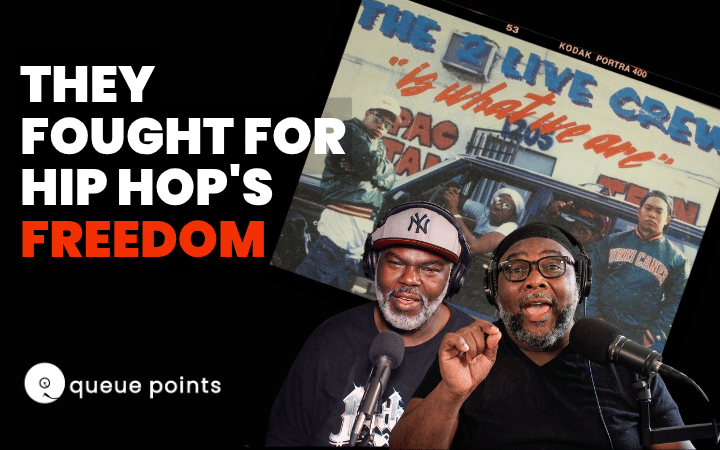
Editor’s Note: Blog post was developed using AI assistance to repurpose content from our original episode, 2 Live Crew: Pioneers of Miami bass and Free Speech, and were subsequently reviewed, fact-checked, and edited by the Queue Points team to ensure accuracy and voice.
The kick of an 808 through a car door doesn’t just shake your chest — it rearranges the block. If you grew up anywhere near Miami in the late ’80s, you remember that feeling: bass rattling your homeroom windows, kids piling into box Chevys, and somebody yelling the words to a 2 Live Crew record they probably shouldn’t have known yet.
That’s the energy DJ Sir Daniel and Jay Ray tap into on Queue Points as they walk through why 2 Live Crew isn’t just a wild footnote in Black music history, but a turning point in hip hop history, Miami bass, and the fight for free speech itself.
Miami Bass Didn’t Come Out of Nowhere
Before courtrooms and warning labels, there was a very specific Florida world that made 2 Live Crew make sense. Sir Daniel remembers moving from New York to St. Petersburg and feeling like he’d stepped into a different timeline: Jheri curls still wet, gold teeth flashing, Impalas and Buicks sitting on rims, and trunks gutted for giant 808 speakers.
“What you have now is a rolling earache… that beat is bumping through your chest.” — DJ Sir Daniel
That “rolling earache” was Miami bass — a local strain of hip hop built on the deep, sustained kick of the Roland TR‑808, fast tempos, hissy cymbals, and lyrics that spoke the language of Liberty City and Overtown.[web:183][web:190] Out of that stew came 2 Live Crew’s debut, The 2 Live Crew Is What We Are, released on Luke Skyywalker Records, the independent label Luther Campbell launched when majors wouldn’t touch the group.
Jay Ray reminds us that the explicitness wasn’t new. Long before Uncle Luke, Little Richard was being told he couldn’t sing “Tutti Frutti, good booty,” and Rudy Ray Moore was rhyming filth over funk as Dolemite. 2 Live Crew sat squarely in that lineage of Black artists who were always “too much” for the mainstream.
“2 Live Crew was not out of nowhere. This group sat in a tradition.” — Jay Ray
“This Is Art. This Is First Amendment.”
Everything changes once As Nasty As They Wanna Be and “Me So Horny” escape Miami and start charting around the world. Suddenly, the same bass that shook teen clubs is on national radio, and Florida authorities decide they’ve heard enough.
In 1990, a federal judge in Florida declared the album legally obscene, making it a crime to sell in several counties. Record store owner Charles Freeman was convicted for stocking it. Members of 2 Live Crew were arrested after performing the material live. Instead of folding, Luke leaned in.
“We knew we were going to get arrested. We were under attack because it was hip-hop.” — Luther Campbell
On appeal, Luke’s label fought back in Luke Records v. Navarro. Scholar Henry Louis Gates Jr. took the stand, explaining that the group’s call‑and‑response, dirty dozens–style lyrics had roots in African American verbal and musical traditions and couldn’t just be written off as filth. Attorney Bruce Rogow argued that the record had “serious artistic value” and should be protected as art. In 1992, the Eleventh Circuit agreed, overturning the obscenity ruling and affirming that music can be explicit without being legally obscene.
Meanwhile, the same state that wanted the record off shelves was literally covering up Black women’s bodies on the album cover with black bars — another reminder, as Sir Daniel and Jay Ray point out, that this wasn’t just about lyrics. It was about who gets to be loud in public, whose bodies are considered obscene, and who the state feels entitled to police.
Fun, Fallout, and an Unfinished Fight
For all the politics, 2 Live Crew still represented pure chaos and fun. Sir Daniel talks about dropping “Hoochie Mama” in a DJ set and watching the room lose its mind. That tension — joy in the crowd, scrutiny from the state — is the heartbeat of this story.
Like a lot of great groups, 2 Live Crew eventually fractured over money and control. Then came another twist: a 1995 bankruptcy that transferred the group’s masters to a new owner.
Decades later, in 2024, a jury ruled that the group could reclaim their catalog through copyright termination rights — only for the Eleventh Circuit to reverse that decision in 2026, sending Luke, DJ Mr. Mixx, and the families of Fresh Kid Ice and Brother Marquis back into legal limbo. The fight over who owns this slice of Black music history is still not settled.
The episode closes with a simple question from DJSir Daniel: Should 2 Live Crew be in the Rock & Roll Hall of Fame? Jay Ray doesn’t hesitate. The way hip hop behaves — onstage, in the club, on the radio — changed because these men decided to fight instead of fold.
And that’s the real story humming under those booming 808s: a local crew from Miami forcing the country to admit that what happens in Black communities, car trunks, and teen clubs is culture — and culture deserves protection.
Watch
How 2 Live Crew's Bold Moves Shaped Music History
Forty years ago, a group out of Miami that no major label would touch released a debut album that sounded like nothing coming out of New York or Los Angeles. The 808 bass...
Listen
2 Live Crew: Pioneers of Miami Bass and Free Speech
In this 40th-anniversary commemorative episode, DJ Sir Daniel and Jay Ray explore why 2 Live Crew defined Miami bass and became a pivotal force in hip hop, not just for t...