
Singers Babyface, Chaka Khan and Whitney Houston appear on stage during the The 38th Annual GRAMMY Awards - Arista Records Pre-GRAMMY Party at the Beverly Hills Hotel on February 27, 1996 in Los Angeles, CA. (Photo by Larry Busacca/Getty Images)
Released on November 14, 1995, the Waiting to Exhale: Original Soundtrack Album did something that had rarely been done in the history of Black film music: it put a single producer in charge of an all-women roster drawn from nearly every lane of R&B, handed him one of the most culturally loaded projects of the decade, and watched him deliver a coherent album with no skips. Thirty years later, the conversation about how that happened — and why it mattered — is still worth having.
The film itself, directed by Forest Whitaker and based on Terry McMillan's 1992 novel, arrived at a specific cultural moment. McMillan's fiction had spent years speaking to Black women with a directness that mainstream publishing largely ignored. The book had a built-in audience that was already primed for the film, and the rollout reflected that — the four leads, Whitney Houston, Angela Bassett, Loretta Devine, and Lela Rochon, appeared together on The Oprah Winfrey Show to push the project. For the soundtrack to land the way it did, it needed to match that cultural weight.
Listen to This Episode
Waiting to Exhale Soundtrack: 1995 Black Music Landmark
This episode explores how the Waiting to Exhale soundtrack became a Black film history milestone, forged by Babyface's focused solo production and a deliberate all-women ...
That responsibility fell to Babyface. By 1995, the partnership between Babyface and L.A. Reid that had defined R&B production since the late 1980s was shifting. Reid had moved decisively into an executive role at LaFace Records, leaving Babyface to operate as a solo producer. The Waiting to Exhale soundtrack came out the year after he produced "Take A Bow" from Madonna's Bedtime Stories — a pairing that underscored how far his reach had extended. This was Babyface at the height of his individual production run, and it shows.
"1995 really does mark the year of Babyface because, you know, prior to this it was L.A. and Babyface. L.A. Reid really began to lean into the LaFace executive producer role — after '94, L.A. Reid is an executive producer. He is not in the studio."
— Jay Ray
The roster was assembled through a combination of network and intentionality. The Arista and Atlanta R&B infrastructure — labels, prior working relationships, and a shared circle of collaborators — accounts for most of the names. Whitney Houston personally selected the artists, and the thread connecting them is largely one of existing professional proximity to Babyface. The more interesting details are in the names that didn't make it. Monica had debuted in June 1995, too recently to be in consideration. En Vogue was navigating internal changes and contractual entanglements with their production team. Anita Baker was in an unsettled period of her career. And Mariah Carey, despite having no documented conflict with Whitney Houston or Babyface — Babyface had in fact contributed to Carey's Daydream the same year — was locked into Sony through her deal with Tommy Mottola, which made a collaboration with an Arista-affiliated project a complicated business proposition.
"I think Mariah Carey was heavily still tied up with Tommy Mottola and that deal at Sony. The whole team was like, 'Love Mariah, but we don't feel like dealing with that Tommy Mottola monster over there.' Had this been a Sony-affiliated soundtrack, we'd probably be having a different conversation."
— DJ Sir Daniel
What makes the album hold up as a body of work rather than a compilation is Babyface's approach to artist-specific songwriting. Brandy's "Sittin' Up in My Room" works because it sounds like exactly what a 15-year-old girl would sing about falling in love. TLC's "This Is How It Works" sounds like a natural extension of the group's existing cadence and T-Boz's vocal character. Each placement is deliberate. Babyface wasn't imposing a singular aesthetic — he was writing to the strengths and identities of each individual artist within a shared tonal world.
The clearest case study in that approach is "Exhale (Shoop Shoop)" itself. When Whitney Houston received the song, her reaction was skepticism. The repetition of the word "shoop" struck her as thin — like Babyface had run out of ideas. She came around, and the single debuted at number one on the Billboard Hot 100, becoming her eleventh and final number-one single. The album reached number one on the Billboard 200, stayed there for five weeks, and has sold over twelve million copies worldwide.
"It's one of those things — its simplicity is probably the best factor of the formula when it comes to making a hit song. And repetitiveness, because as soon as she fell into that chorus of shoop shoop, we all fall into that shoop shoop with her."
— DJ Sir Daniel
The Waiting to Exhale soundtrack didn't just document a moment in 1990s R&B — it concentrated it. Every name on the tracklist, from Aretha Franklin and Chaka Khan to Faith Evans and CeCe Winans, represents a distinct strand of Black women's vocal tradition. Babyface found a way to honor each of those traditions without flattening them into a uniform sound. That's the craft argument for why the album still resonates. The cultural argument is simpler: Terry McMillan wrote something that Black women had been waiting to see reflected, and the music matched it.
Watch
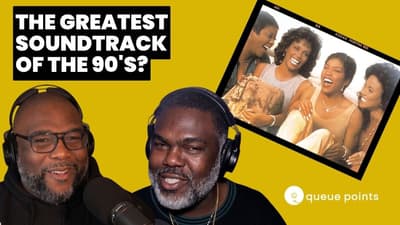
Why Whitney Thought “Shoop Shoop” Wouldn’t Work
Whitney Houston’s initial doubt about the lead single “Exhale (Shoop Shoop)” becomes the entry point for a deep dive into the 1995 Waiting to Exhale soundtrack, exploring...
Editor's Note: Blog post was developed using AI assistance to repurpose content from our our original episode, Waiting to Exhale Soundtrack: 1995 Black Music Landmark, and were subsequently reviewed, fact-checked, and edited by the Queue Points team to ensure accuracy and voice.