
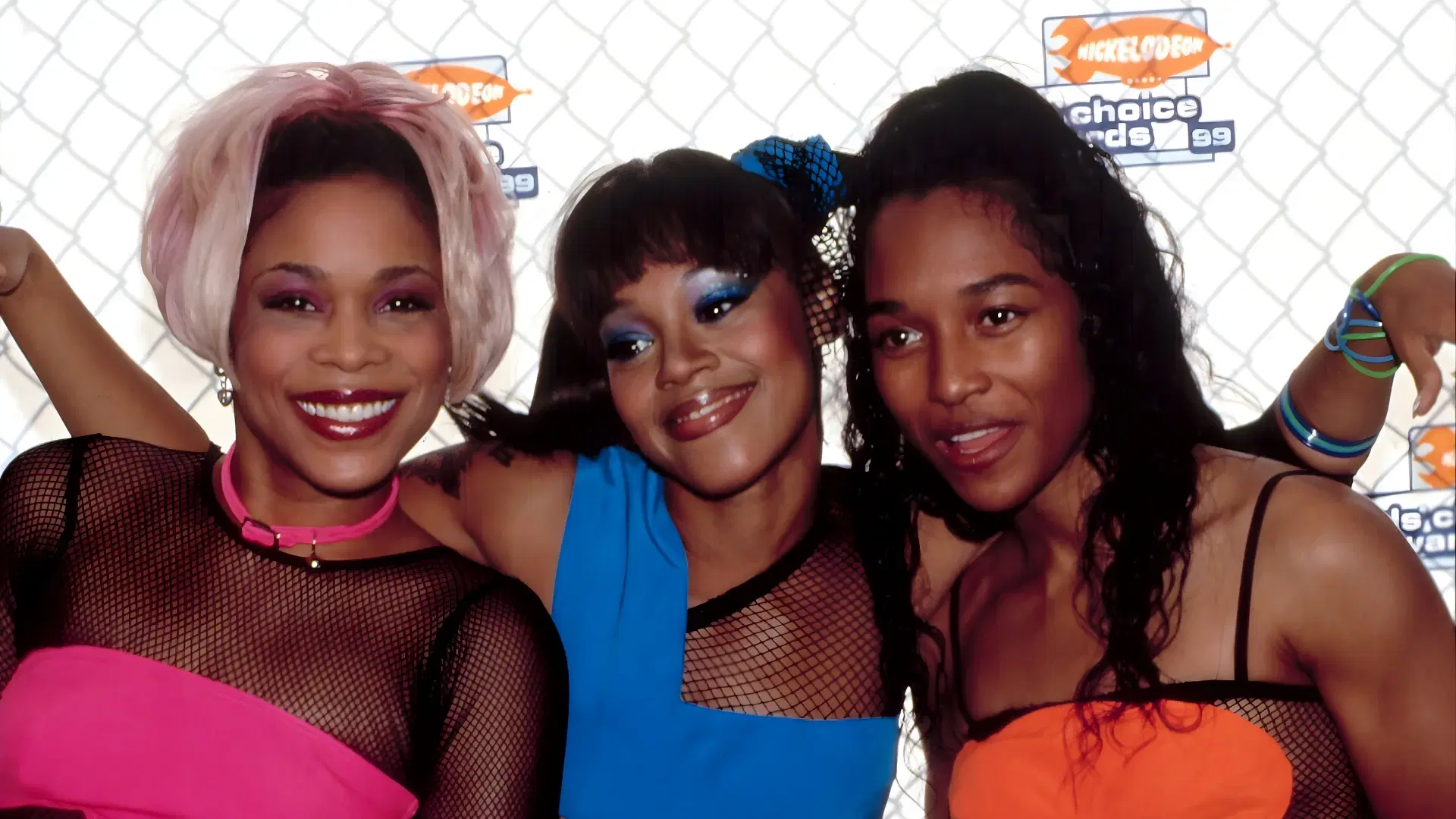
TLC: Rozonda 'Chilli' Thomas, Tionne 'T-Boz' Watkins & Lisa 'Left Eye' Lopes at Nickelodeon Kids' Choice Awards, 1999 — Photo by everett225
The first time TLC crashes onto the screen in this episode, it isn’t through a think-piece or a textbook—it’s through memory. Sir Daniel is back in Atlanta, TV glowing, watching “Ain’t 2 Proud 2 Beg” on American Music Makers, struck by three Black girls in big floppy hats and condom accessories who look grown but still feel like the kids you might see at the mall.
Listen To This Episode
TLC: Legacy, Money and Music Industry Lessons
Sir Daniel and Jay Ray revisit TLC’s rise, marking the 34th anniversary of “Ooooooohhh... On the TLC Tip” and tracing Ain't 2 Proud 2 Beg's 1992 breakout, Pebbles’ influe...
Start Listening Now → Apple Podcasts / Spotify / YouTube
That’s the heartbeat of this Queue Points conversation on TLC: Legacy, Money and Music Industry Lessons—it sits right where Black music history, R&B culture, and community joy overlap. TLC isn’t just a group here; they’re a way to talk about how Black art moves from the salon to the stage, from girl group dreams to production deals and flow charts, from Atlanta’s bubbling scene to boardrooms that treat records like loans.
The story starts small: Crystal Jones holding auditions to form a girl group, Tionne “T-Boz” Watkins known around town as the shampoo girl at a local salon, and Pebbles walking into that same shop and recognizing something in these young women. That salon, as Sir Daniel points out, was full of “real Housewives of Atlanta before there were Real Housewives”—Black women with money and means getting their hair done, moving through an Atlanta that felt close-knit and only “one person removed” from possibility.
From there, the narrative opens out into the wider map of Black music history. Dallas Austin builds a wall-of-sound on Ooooooohhh… On the TLC Tip—a pile-up of samples, knocking drums, and Left Eye’s “mic check 1, 2, 1, 2” slicing through like a siren over the track. Chili’s smooth R&B hook floats on top, while T-Boz’s husky lead makes the record feel like nothing else on the radio at the time. The album becomes a launchpad not just for TLC, but for Dallas Austin, Jermaine Dupri, LA Reid, Babyface, and Darryl Simmons, as LaFace Records starts defining what 90s R&B culture and hip-hop-adjacent pop can sound like out of Atlanta.
Watch This Episode
How TLC Got Played… Then Changed the Game for Everybody
Remember flipping past BET and catching "Ain't 2 Proud 2 Beg" for the first time—big floppy hats, condom on their eyeglasses, Left Eye cutting through Dallas Austin's wal...
“We were so lucky in 1992… y’all don’t understand how blessed we were musically in 1992.”
– DJ Sir Daniel
Jay Ray connects that moment to a bigger cultural shift. It’s 1992, and girl groups and women MCs are everywhere—Salt-N-Pepa, Queen Latifah, Monie Love—and SWV is this close to being named TLC before the original TLC hits and changes their plans. At the same time, Atlanta radio is spinning Organized Noize productions, Witchdoctor, and a host of local voices that make people across the country think, “I need to go there.” TLC becomes a gateway: a group that pulls you into a city, a sound, and a community.
But it isn’t just about the music.
Once the conversation shifts to CrazySexyCool, Sir Daniel and Jay Ray talk about how TLC’s image grows up in front of us. The big, baggy, cartoonish looks of the first album give way to the sensual, grown-woman energy of “Creep” and that “Hat 2 da Back” moment when the oversized clothes come off and you see the bodies underneath. It’s a lesson in artistic fearlessness—redefining yourself without losing your core—and a reminder that Black women in R&B have always had to negotiate youth, desirability, and respect onstage.
“Fearlessness is a lesson that you learn from CrazySexyCool… growth and not being afraid to grow and change.”
– DJ Sir Daniel
That’s where the conversation gets real about money. Jay Ray breaks down production deals like a quick “music school” segment: you don’t sign directly to the label, you sign to a producer’s company, they sign to a label, the label is tied to a bigger corporation. In TLC’s case, they’re signed to Pebbitone (Pebbles’ production and management company), which signs with LaFace, which sits under Arista, with BMG up top. Every extra layer stands between the artist and the money.
Sir Daniel calls record labels what they are: banks. They front the money, they treat artists like assets, and that magic word “recoup” controls everything. Every video, wardrobe pull, and Tylenol on tour gets charged back—like a hospital bill—and by the time the dust settles, three women who sold millions of records, filled stadiums, and helped reshape pop radio walk away with checks that don’t match the work.
“They become a teacher of the business of music… how do these women that just sold all of these records… still not be rich?”
– Jay Ray
Lisa “Left Eye” Lopes becomes the clearest voice on that reality. The hosts talk about her famous “get your calculators out” breakdown of how TLC could be the number one selling group and still be broke, a clip Sir Daniel insists should be in every accounting syllabus, not just in music business programs. They also honor her creativity beyond the headlines: her work helping shape acts like Illegal, her unforgettable features on tracks like Donell Jones’ “U Know What’s Up” and Lil’ Kim’s “Not Tonight (Remix),” and the Supernova project that only got a proper release overseas but still circulates among dedicated fans.
Underneath all of it is a story about Black women, vulnerability, and the cost of visibility. The conversation moves through Lisa’s very public struggles, T-Boz’s health battles, and Chili’s personal life being picked apart in magazines and blogs. TLC isn’t just a case study in how the music industry treats Black artists; they’re an example of how the world feels entitled to their entire lives—the music, the drama, the pain.
And yet, there’s so much love in how Sir Daniel and Jay Ray talk about them. They sit with the grief of losing Left Eye, remembering that first MTV appearance where T-Boz and Chili stepped on stage as a duo and could barely speak. They also sit with the joy of knowing that somewhere, a little Black girl will see the “Ain’t 2 Proud 2 Beg” video for the first time and feel that same shock of recognition they felt in 1992. That’s Black music history in motion—memories turning into new possibilities, again and again.
“There is no TLC without the three of them… the spirit of Lisa Left Eye Lopes is always in everything that they do.”
– Jay Ray
Get the stories behind the episodes.
The Queue Points Insider lands every Thursday with what we're working on, what's coming next, and the stories that don't make the episode.
Subscribe Today