

⚠️ Content Note: This episode discusses child sexual abuse and sexual violence. If you or someone you know needs support, RAINN is available at 1-800-656-4673 or rainn.org.
Picture a SoundCloud playlist, circa 2017. You're deep in a rabbit hole of independent music — beats you've never heard, vocalists you can't place, producers who exist in the margins between the mainstream and something else entirely. A name shows up in the mix: 3God Productions. The music isn't for everybody, but it isn't bad. You skip past it. You keep scrolling. You have no idea what that name is about to become.
Listen to This Episode
Dr. York, The Cult of NatureBoy & the Music Behind the Harm
This episode of Queue Points examines how music, charisma, and community-building can be manipulated to cause real harm, connecting The Cult of the NatureBoy documentary ...
That's where Jay Ray picks up the thread on this episode of Queue Points. What started as a conversation about the viral The Cult of the NatureBoy documentary quickly became something deeper: a full excavation of the ways Black music history has been used — not just to uplift and heal — but to gather, manipulate, and harm. And it turns out this story has roots that go back much further than SoundCloud.
"There's always a through line with cults and cult leaders, Jay Ray — that is a direct connection to music."
— DJ Sir Daniel
The name at the center of that history is Dr. Malachi York. Before he founded the Nuwaubian Nation, before the compound in Eatonton, Georgia, before the 2004 conviction and 135-year federal sentence, Dr. York was a working musician in Brooklyn. He ran Passion Studios. He founded York's Records and Passion Records. He produced doo-wop influenced slow jams and ballads, pressing records that actually moved. His most recognizable production credit is "He's So Fine" by Petite — the New Edition answer record that Sir Daniel, in a genuine "wait, what?" moment, realized he had loved for years without knowing who made it.
But that's almost a footnote compared to the ideological footprint. Dr. York began preaching during the Black Power Movement in late 1960s Brooklyn, weaving together elements of the Nation of Islam, the Moorish Science Temple, and the Five Percenters into something distinctly his own. Those teachings moved through the culture in ways most people never tracked. Afrika Bambaataa and the formation of the Universal Zulu Nation carry his influence. Early Jay-Z and Jaz-O visuals carried his imagery. Mobb Deep had connections to his orbit. This was the soundtrack of a generation of young Black men trying to make sense of crack-era New York, and he was in the room while that soundtrack was being written.
"New York looks like an atomic bomb went off in certain places where mostly Black and brown people live. And as we're seeing the rise of hip hop — the voice of the young people — we're seeing that ascension happening alongside people looking for answers and looking for someone to guide them."
— DJ Sir Daniel
That's where the conversation got real. Because the conditions that made Dr. York's promise feel worth following in 1970s Brooklyn are not relics. Sir Daniel described working at a drop-in center for youth experiencing homelessness when a young man wouldn't stop talking about NatureBoy. Ferguson had just happened. George Floyd and Sandra Bland were still fresh wounds. The country was cooking. A charismatic man offering a Black utopia, a community, a studio, a sense of purpose — that is not a hard sell when everything else has already failed you.
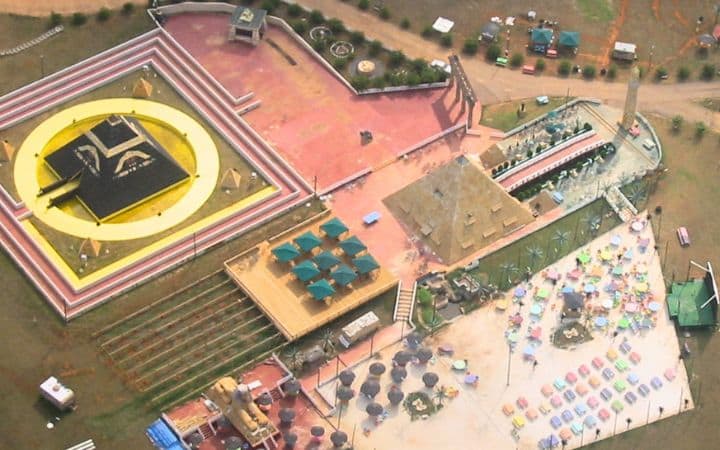
By the 1990s, Dr. York had moved the Nuwaubian Nation to a compound in Georgia, complete with hand-built pyramids, sphinxes, and statues. At the same time, two hours away in Atlanta, OutKast was dropping ATLiens — an album full of the exact same ancient Egyptian and alien imagery. Same era. Same soil. The culture was absorbing and reflecting this energy without most people realizing the source.
And then it all collapsed in the worst possible way. Dr. York was arrested in 2002 and convicted in 2004 on over 100 counts of child sexual abuse, with prosecutors noting the actual scope of the harm may have exceeded a thousand cases. He is serving 135 years. Eligio Bishop, NatureBoy, is serving a life sentence. The music was real. The community was real. The harm was real too.
"Music has the power to heal. Music also has the power to harm. Pay attention to those frequencies."
— Jay Ray
That's the line that stays with you long after this episode ends. Not as a warning to stop trusting music — but as a reminder that the same qualities that make a song feel like it was written specifically for you, the intimacy, the directness, the sense of being truly seen, are the same qualities a manipulator studies and weaponizes. DJ Sir Daniel closes with a quiet, steady reminder that holds right now as much as it ever has: mind the energy. Your instincts are never wrong.
This is Black music history doing what Queue Points does best — not letting the story stay comfortable, and not letting the warning go unspoken.
Editor’s Note: These show notes were developed using AI assistance to repurpose content from our original episode, Dr. York, The Cult of NatureBoy & the Music Behind the Harm, and was subsequently reviewed, fact-checked, and edited by the Queue Points team to ensure accuracy and voice.