
![[Show Notes] TLC: Legacy, Money and Music Industry Lessons](https://images.beamly.com/fetch/https%3A%2F%2Fsites.beamly.com%2F65e385bcdcfc57fb25f741f6%2Fmedia%2Fa7db973a090a8e8f4dc3.webp?w=1200)
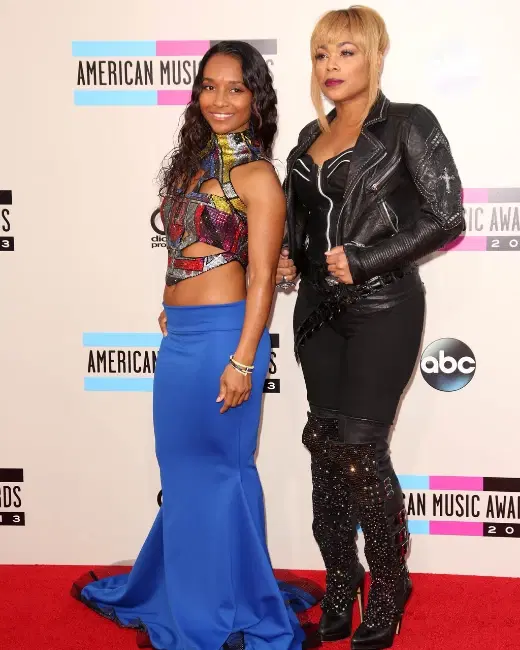
Chilli and T-Boz at the 2013 American Music Awards at the Nokia Theatre, LA Live. November 24, 2013 Los Angeles, CA — Photo by s_bukley
Show Notes
The Big Picture
Sir Daniel and Jay Ray sit down to celebrate the 34th anniversary of Ooooooohhh… On The TLC Tip and honor one of the most important girl groups in Black music history. They trace TLC's path from Atlanta salon auditions and Pebbles' vision, through LaFace 1.0 reshaping 90s R&B and hip hop, all the way to the flow charts and recoupment clauses that left three diamond-selling women with checks that didn't match the work. It's the kind of conversation that feels like sitting around with your cousins who actually did the research—part celebration, part music business masterclass, all love.
Listen To This Episode
TLC: Legacy, Money and Music Industry Lessons
Sir Daniel and Jay Ray revisit TLC’s rise, marking the 34th anniversary of “Ooooooohhh... On the TLC Tip” and tracing Ain't 2 Proud 2 Beg's 1992 breakout, Pebbles’ influe...
Start Listening Now → Apple Podcasts / Spotify / YouTube
The Salon, The City & The Sound That Didn't Fit Any Box
TLC's origin story starts in Atlanta—close-knit, accessible, and buzzing with possibility. Crystal Jones held auditions to form a girl group; T-Boz (Tionne Watkins) was known around town as the shampoo girl at a local salon full of "real Housewives of Atlanta before there were Real Housewives." Pebbles (Perri Reid) had the insight to put the pieces together.
"Ain't 2 Proud 2 Beg" hit TV screens on American Music Makers and stopped Sir Daniel cold at 16—big floppy hats, condom glasses, and every shade of Black girl represented at once.
Dallas Austin built a wall of sound on the debut: layers of samples, dense drums, and space for Left Eye's "mic check 1, 2, 1, 2" to cut right through.
The debut album served as a launching pad for Dallas Austin, Jermaine Dupri, L.A. Reid, Babyface, and Darryl Simmons, cementing LaFace's Atlanta as a new center of gravity for R&B and hip hop.
T-Boz and Left Eye quietly appear in Pebbles' "Backyard" video with Salt-N-Pepa before Chilli even joins—stripped back, ponytails, no TLC gear yet.
1992 Was a Blessing: Girl Groups, Atlanta Bubbling Up & SWV's Near Miss
The hosts are clear: 1992 was a musically stacked year. Salt-N-Pepa, Queen Latifah, and Monie Love were all in motion when TLC arrived—and the city of Atlanta was quietly becoming a destination.
SWV (Taj, Coko, Lelee) nearly named themselves TLC before Ooooooohhh… dropped and forced a pivot—a small decision that changed how we remember two iconic groups.
Jay Ray recalls hearing Organized Noize-driven sounds on Atlanta radio in 1997 and immediately knowing: "I want to go to Atlanta because this is able to happen in this spot."
TLC became a gateway group, pulling a whole generation toward the city and signaling that Black girl group artistry could anchor an entire regional music movement.
From Baggy Jeans to CrazySexyCool: Fearless Artistic Growth
The hosts sit with TLC's evolution—from colorful, cartoonish debut energy to the sensual, grown-woman power of CrazySexyCool.
"Hat 2 Da Back" was the first crack in the baggy armor—the video where the oversized clothes come off and fans saw, as Sir Daniel puts it, "they're chiseled, flat stomachs, they look womanly."
The original "Creep" video was camcorder-raw and very different from what fans know; the polished version we got helped reframe TLC's identity entirely.
Sir Daniel frames CrazySexyCool as a lesson in fearlessness: "You couldn't have told me that they would've gone in this direction for the second album. And it worked to their benefit."
The progression from debut to CrazySexyCool to FanMail becomes what Jay Ray calls "forks in the road about what people can do"—a trilogy that reshaped 90s R&B culture.
Flow Charts, Recoupment & Left Eye's Calculator
This is where the music business class really begins. Jay Ray breaks down production deals step by step, using TLC as the example.
TLC's deal stack: Signed to Pebbitone (Pebbles' production/management company) → Pebbitone signs to LaFace → LaFace sits under Arista → Arista under BMG. Multiple hands in the pot before money ever reached the group.
Sir Daniel calls record labels what they are: "pretty much banks." They advance money, treat artists like assets, and obsess over recoupment—every expense (studio, videos, tour support, promotion) charged back before royalties kick in.
His hospital analogy: "If they give you a Tylenol, best believe there's gonna be a $500 Tylenol on that invoice."
Lisa "Left Eye" Lopes' famous "get your calculators out" breakdown of how TLC became the number one selling group in the world and still went broke is described as required viewing for any accounting or capitalism class—not just music business.
Jay Ray notes that $50,000 checks per member is the reported reality behind stadiums full of fans and diamond certifications—a gap that forces listeners to reckon with how Black artists are compensated.
Left Eye's Magic & The Cost of Visibility
When the conversation shifts to honoring Lisa "Left Eye" Lopes, the tone deepens. Her legacy extends far beyond TLC.
Behind the scenes, Left Eye shepherded groups including Illegal and Blaque through the industry—mentoring quietly while rarely getting credit.
Her feature work is legendary: Sir Daniel says if you DJ and play Donell Jones' "U Know What's Up" without Left Eye's version, "it's curtains for you." Her verse on Lil' Kim's "Not Tonight (Ladies Night Remix)" still shuts down parties.
Her Supernova project—released overseas only—is a collector's treasure. "If you have it, you have it."
T-Boz and Chilli have continued, but they both acknowledge that later projects didn't hit the same. As Sir Daniel puts it: "The main spice, the main ingredient to what we are, is no longer here."
The hosts recall T-Boz and Chilli's first MTV appearance after Lisa's passing—visibly shaken, barely able to speak. "Imagine looking to your left or your right, thinking you're going to see your sister, and they're not there."
Jay Ray closes the tribute with something simple and true: "There is no TLC without the three of them. The spirit of Lisa Left Eye Lopez is always in everything that they do."
FAQ: Your Questions About TLC, Money & the Music Industry
Q: How could TLC sell millions of records and still go broke?
A: Their deal involved a low royalty rate, multiple corporate layers (Pebbitone → LaFace → Arista), and strict recoupment, where all costs were deducted from their share before they saw real money. The structure favored labels and production companies over the artists.
Q: What exactly is a production deal, and why is it risky?
A: In a production deal, you sign to a producer's company instead of directly to a label. The producer shops you to labels, but the production company—not you—holds the deal. Your income is filtered through that extra layer, reducing transparency and your share.
Q: Why do the hosts say record labels are like banks?
A: Labels "loan" money via advances and budgets, then charge every single expense against your future royalties. Until that balance is fully recouped, most revenue stays with the label—just like a high-interest loan you can't easily pay off.
Q: What makes TLC important to Black music history beyond the business drama?
A: They fused R&B, hip hop, and pop in a way that opened doors for later acts; they modeled safe-sex messaging and every-shade Black girl representation; and their trilogy of albums—Ooooooohhh…, CrazySexyCool, and FanMail—became reference points for what Black girl group artistry could achieve.
Q: What was Left Eye's impact beyond TLC?
A: She mentored acts like Illegal and Blaque, delivered some of the most memorable guest verses of the 90s, recorded the experimental Supernova project, and had an almost-deal with Death Row Records. Her creativity was far bigger than any one group.
The Ultimate Takeaway
"We in 2026 are sitting here still honoring that impact. There's gonna be little girls that see that 'Ain't 2 Proud 2 Beg' video in 2027. They are literally going to do the same thing that we did in 1992 when we saw it. That was magic."
— Jay Ray
Bibliography & References
Related Queue Points Episodes
From "I Wanna Be Down" to "Ladies Night": Classic Women in Rap Posse Cuts
Pink, LaFace 2.0 and Atlanta’s Black Pop Moment [Insiders Only]
Music
Music Videos
TLC – Ain't 2 Proud 2 Beg (Official Video): The debut TLC video on the LaFace/Arista label that Sir Daniel recalls watching on American Music Makers and being immediately struck by the group's color, energy, and mixed-shade representation. Central to the episode's opening discussion.
TLC – Creep (Official HD Video): The "Hat 2 Da Back" video is cited by Sir Daniel as the moment fans first glimpsed TLC's womanhood beneath the baggy clothes — a key turning point in their visual evolution discussed in the episode. (Watch the rare, unreleased, music video for the song "Creep")
TLC – Hat 2 Da Back (Official Video): The "Hat 2 Da Back" video is cited by Sir Daniel as a key turning point in their visual evolution discussed in the episode.
TLC – Waterfalls (Official HD Video): TLC's signature hit, featuring Left Eye's defining rap verse. Referenced throughout the episode as a cultural landmark of the CrazySexyCool era and one of the album's most fully collaborative tracks.
TLC – Diggin' On You (Official HD Video): The concert-style video Jay Ray references when noting the gap between TLC's global reach — thousands of fans in stadiums — and the modest checks they actually took home.
Pebbles ft. Salt-N-Pepa – Backyard (Official Video): Sir Daniel recounts spotting a pre-TLC T-Boz and Left Eye in this Pebbles video with stripped-back looks and no Chilli yet, illustrating how Pebbles used her position to develop the group before their official debut.
Donell Jones – U Know What's Up (Official Video): DJ Sir Daniel calls out Left Eye's verse on this track as a mandatory DJs-must-play cut, calling it "curtains" if you don't play her version. A testament to Left Eye's standalone legacy beyond TLC.
Lil' Kim ft. Left Eye, Missy Elliott, Da Brat, Angie Martinez – Not Tonight (Ladies Night Remix): Left Eye's verse on this iconic remix is praised by Sir Daniel as one of the best features of her career. The video also features T-Boz and Chilli cameos, making it a double TLC moment.
Articles for Context & Research
TLC on Reclaiming 'Queens of Girl Power' Status – Rolling Stone: Rolling Stone feature with T-Boz and Chilli discussing TLC's legacy of blending hip hop and R&B, and the influence of Dallas Austin and LaFace's production. Provides authoritative context for the episode's discussion of TLC's cultural place in pop history.
CrazySexyCool at 30: How TLC Destroyed the Auteur Theory in Pop – The Quietus: Acclaimed 30th-anniversary critical essay on CrazySexyCool's layered creativity, bold sexuality, and artistic fearlessness. Directly relevant to the episode's section on TLC's evolution from debut to mature womanhood.
Feature: Let's Do It Again – TLC's CrazySexyCool at Thirty – Music Musings and Such: In-depth album retrospective examining how CrazySexyCool — produced with Organized Noize and Dallas Austin — pushed the boundaries of R&B. Covers Left Eye's pivotal contributions and T-Boz's deep-register storytelling discussed in the episode.
TLC's Contracts With Pebbles Explained – Hello Beautiful: Clear breakdown of TLC's contentious management deal with Pebbles, including alleged conflicts of interest, ownership of the TLC name, and the $3 million buyout. Directly supplements the episode's production deal and exploitation discussion.
LaFace Records – New Georgia Encyclopedia: Reference entry on LaFace Records' founding, Atlanta roots, and role in shaping 90s pop, R&B, and hip hop. Essential context for the episode's discussion of LaFace 1.0 and TLC's role in building the label's legacy.
How Atlanta Became the Center of the Rap Universe – NPR: NPR's definitive piece on Atlanta's rise as a hip hop and R&B capital, tracing the same mid-90s Organized Noize/LaFace/Jermaine Dupri ecosystem the hosts describe when discussing TLC's context and the city's "palpable bubble" in the early 90s.
Inside Atlanta's Music Scene – NPR: NPR feature noting that Atlanta's late 80s and early 90s scene — anchored by L.A. Reid, Babyface, Jermaine Dupri, Dallas Austin, and TLC — defined an R&B era. Supports the episode's claim that Atlanta was the center of a new music gravity.
The Music Industry Has Exploited Black Artists Since Its Inception – CBC Documentaries: Columbia University–hosted article on systemic underpayment of Black artists and the historical legal barriers behind it. Frames TLC's financial story within a much longer pattern of inequity in the music business.
The Fight for Fair Compensation for Black Musicians – Columbia Law: Columbia University–hosted article on systemic underpayment of Black artists and the historical legal barriers behind it. Frames TLC's financial story within a much longer pattern of inequity in the music business.
Salt-N-Pepa – Wikipedia: Comprehensive background on Salt-N-Pepa, the group Sir Daniel cites as a contemporaneous example of women who had "crossed over" when TLC arrived in 1992, helping contextualize the girl group landscape TLC disrupted.
People & Places
Genres & Formats
Rhythm and Blues (R&B) – Wikipedia — Popular music rooted in African American communities, blending blues, jazz, and gospel; the core sound of TLC's catalog.
Hip Hop – Wikipedia — Culture and genre emerging from the Bronx in the 1970s, built on DJing, MCing, breakdance, and graffiti; the sonic layer Left Eye brought to TLC's identity.